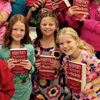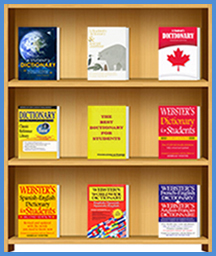
| Over 7,544,612 children have received a dictionary thanks to the generosity of sponsors who have participated in the Dictionary Project. Sponsors provide a dictionary for the children in their community each year, so they can enjoy the benefits of a large vocabulary.
2,331,915 dictionaries were given to students in 2007 as a gift from people who live in their town.
is a 501(c) (3) nonprofit organization. The goal of this program is to assist all students in completing the school year as good writers, active readers and creative thinkers by providing students with their own personal dictionary. The dictionaries are a gift to each student to use at school and at home for years to come. The Dictionary Project gives 95 cents of every dollar donated toward the purchase of dictionaries.
Reading is the most important skill of all. It is the starting point for all the economic and social opportunities this world has to offer. Educators see third grade as the dividing line between learning to read and reading to learn. Every year we watch The Dictionary Project grow by expanding our pool of sponsors, so more children can enjoy the benefits of owning their own personal dictionary.
Our sponsors have made tireless efforts to improve literacy and the quality of life in their communities. These volunteers are the breath of life of The Dictionary Project. Through The Dictionary Project, people feel empowered to affect change and improve education so that the children will grow up better prepared to compete in the global economy.
Michael Gamber and Virginia Gamber Hanks Memorial Grant
|
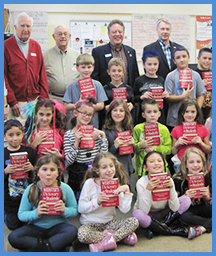
| Linda Keetch shares the dictionary with students in the Lucia Mar district. |
My husband and I recently distributed over 850 dictionaries to the teachers and third-grade students of the Lucia Mar Unified School District on the Central Coast of California. We visited over 40 classrooms at 11 elementary schools.
I spent a few minutes telling each class that my father had come to the United States from Italy with only his first language, Italian. He learned English in school, and he always loved both of his languages. He studied English all of his life, and he often read the dictionary to learn something new. Many of the students in the Lucia Mar District are bilingual, and I hope my father`s story will let them know what a gift it is to speak in two languages.
The students thanked us while we were in the classrooms, and many of them have also written to us. One girl wrote in her letter, `I will become smart with this dictionary.` Several others told us that their dictionaries will help them become scholars. If the students use their dictionaries, they will indeed become smart scholars. That will make my husband and me very happy.
By: Moe Bohannon Oakes Times /
Tuesday, September 18, 2007
Donor: Woody and Jean Gulsvig
|
| Third graders in Oakes Public School are shown with their new dictionaries. Also shown are third-grade teachers Mrs. Gemar and Mrs. Miller, and Woody and Jean Gulsvig, who donated the dictionaries. |
`We had four children and three grandchildren graduate from Oakes Public School, and we feel we want to give back to the School in gratitude for their education,` stated Woody and Jean Gulsvig.
The Gulsvigs have begun a tradition on this day, Thursday, September 6, 2007, of presenting each third-grade student with a dictionary.
Woody found out about this program from a Rotary Club in Arizona, where the Gulsvigs go for the winter months. The program is called the Dictionary Project and is based in Charleston, South Carolina. The Gulsvigs stated they will continue the program as long as they are able and then hope someone will take over from them.
The third-grade students and their teachers, Mrs. Gemar and Mrs. Miller, were very excited and pleased with the gift. Many of the youngsters came up to the Gulsvigs and thanked them personally for the gift.
The gift is not just a dictionary; it also contains many facts the students can use as they continue their education. Each student was also given a quiz to take and turn in to their teachers.
Dear Mary,
My wife, Johnnie, and I are in our eighties. Married for sixty years, we are not parents. Our experiences with children are with nieces and nephews (now themselves parents) and with other people's children. Our decision to spend $1,100.00 for the Dictionary Project has brought us more pleasure than any expenditure we've made. I enclose selected responses from dictionary recipients .. All those responses are precious to us….Lastly, Mary, I acknowledge my father's devotion to our language. His continued insistence on my using our language correctly while I was growing up has enriched my life. Peoria , IL
Click here to view the letter and the pictures enclosed
Jim Collar - POST-CRESCENT EAST - 11/23/2007
KIMBERLY - - The first word Kimberly's third-graders may want to look up in their new dictionaries falls under the letter T.
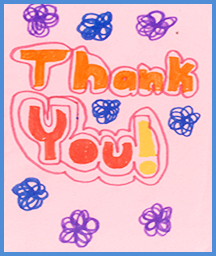
Thanks.
Kimberly residents Chuck and Lea Rundquist donated one dictionary to each third-grade student in the Kimberly Area School District. The Rundquists purchased the books through the national Dictionary Project.
The purchase and distribution of the books often is a project of service organizations, but with no service groups to complete the project in the Kimberly area, the Rundquists decided to it themselves.
Both are retired teachers. Chuck Rundquist is a member of the district's school board.
"It's an excellent program," Lea Rundquist said. "I'm just excited about it."
Students at Kimberly's West-side Elementary School gave a resounding thank-you to the couple last week when they handed a paperback dictionary to each student.
The dictionaries were designed specifically for third-graders. It's an age of transition, Chuck Rundquist said, when children move from learning to read to reading to learn.
The couple needed 328 dictionaries for the entire district.
Referring to the cost, Lea Rundquist noted her husband's upcoming three-month teaching job in Kaukauna.
"His paycheck's already been put aside," she said with a laugh.
Chuck Rundquist walked Westside's third-graders through the book before distributing them. The dictionary includes presidential biographies and the periodic table of elements.
He directed children to the last page of the book, which featured the longest word in the English language. It took up the entire page.
One child asked if he could pronounce it. "Absolutely not," Rundquist said, drawing laughter.
The Dictionary Project began in 1995. Nearly 7 million children have received a dictionary as part of the program. Kaukauna third-graders recently were given dictionaries as part of a project by the Elks Club.
According to the Dictionary Project, the goal is to increase reading ability and comprehension, and to encourage children to use dictionaries to grow their English skills.
Kimberly youngsters were excited to receive theirs.
The students immediately began flipping through the paperbacks with smiles on their faces as they were ushered back to their classrooms.
"It's a very small thing to do to give back to this district," Chuck Rundquist said.
Lea Rundquist said the value of what the children gain from the book will far exceed the cost.
"If we can, we're going to do it every year," she said.
Photo Credit: CHUCK AND LEA RUNDQUIST of Kimberly distribute dictionaries to third-graders at Westside Elementary School last Wednesday.
Meet Ted Utchen
Judy Buchenot The Wheaton/Glen Ellyn Glancer - 06/01/2007
All third graders in District 200 can look up the word `generous` thanks to retired Wheaton resident Ted Utchen. For the past five years, Utchen has given every third grader a manageably sized, soft cover dictionary which includes maps, tables and other educational information.
Utchen began handing out the dictionaries in 2003 after reading a Wall Street Journal story about Mary French and The Dictionary Project. French founded the non-profit organization, which gives children dictionaries, in 1996. Sponsors can obtain dictionaries through the organization at a reduced cost to give to children in the community of their choice. The program has grown, and more than 5,142,588 dictionaries have been given to children since the first year. In 2006 alone, 1,939,536 dictionaries were given to students by individuals or groups. Foundations and civic organizations like Rotary Clubs have joined in the effort in many towns across the United States .
Utchen personally covers the $2 sponsorship cost per dictionary. In 2006, he gave 1,005 dictionaries to students, and this year he gave out 933. He also generously gives his time to this project by visiting each of the district`s 44 third-grade classes over a one-month period. He challenges the children to become regular users of the dictionary through a 30-minute presentation. `If we can get children started using the dictionary when they are young, it can help them to grow,` he explains. `So much of life consists of communication. I am a retired vice-president and general counsel of a Chicago corporation, and one of my concerns used to be the amount of written material I would receive from adults with misspelled words.`
During his presentation, Utchen tells students that he grew up without a computer and had to struggle to learn to use one when he was much older. He then points out that learning to use the dictionary at a young age will be easier than waiting until they are older. `Every year, I get thank you notes from the children, and one or two students will offer to come teach me how to use my computer,` he fondly recalls.
Utchen shares the story of his work in hopes that sponsors from other communities will become part of The Dictionary Project and distribute even more dictionaries. He is willing to help individuals or groups establish contact with non-profit organizations. `This is a worthwhile thing to do,` he notes. `It can make a difference in children`s lives.` Why We Work in South Carolina
We wanted to understand why The Dictionary Project, which has been well received in most states, was virtually ignored in South Carolina for years. Every third-grade student in South Carolina public schools has received a dictionary for the past eight years, thanks in part to donations from people all over the country and Rotary Clubs in Districts 7770 and 7750. Unfortunately, we have not found local sponsors in much of the state. We believe that these pictures of schools in South Carolina clearly demonstrate that the people responsible for making education policy and funding decisions in this state do not understand the value of education, or grasp that it is an integral part of a prosperous economy.
Corridor of Shame ( http://www.dictionaryproject.org/corridor_of_shame.asp )
Recently the former superintendent of Charleston County schools had this to say about the school district:
http://www.charleston.net/news/2007/jun/14/pointed_words_good_feelings/ (click on link to open)
It wasn't until 1992 that standardized tests were mandated by the state of South Carolina and administered to the students to evaluate the level of education each child received in school. The test scores validated the SAT scores already on record that ranked South Carolina 50th in the nation. SAT scores in South Carolina are rising more quickly than those of the nation as a whole, but are still well below the national average. South Carolina average scores in 2007 were 488 Critical Reading , 496 Mathematics, and 475 Writing; United States average scores in 2007 were 502 Critical Reading , 515 Mathematics, and 494 Writing. (The SAT scores on a 200-800 point scale in each subject area.) The percentage of students meeting state standards in Language Arts on the 2007 Palmetto Achievement Challenge Test (PACT) is over 85% for third graders, but falls for higher grades, to just 71% of eighth graders who meet standards. PACT scores also show significant racial disparities: While 67% of white students score proficient or advanced in Language Arts, only 38% of African-American students attain such scores. High school graduation rates, depending on the methodology used to compute them, show that somewhere between 30 and 50 percent of entering ninth graders will fail to graduate within four years. This rate is among the worst in the nation. Overall graduation rates reported by the South Carolina Department of Education have fallen every year since 2003.
(Statistics are available on the South Carolina Department of Education website, www.ed.sc.gov . Other graduation-rate studies are at http://www.unitedhealthfoundation.com/shr2004/components/hsgrad.html and http://www.manhattan-institute.org/html/cr_baeo_t2.htm .)

If you would like
to start a Dictionary Project Click
Here
To find a list of Dictionary
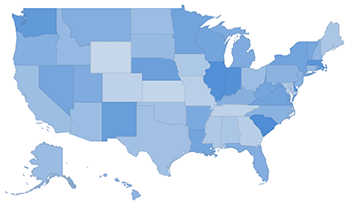
Projects in your state, choose from the list below:
|